It all began with a humble experiment I once witnessed in a friend’s laboratory.
What started as a curious spark grew into something far more ambitious.
With Laserpoints and LDR sensors, we built our first prototype — a fragile machine that dared to measure the unseen. Then came a turning point: we bought a 3D printer. Suddenly, ideas could take shape, not just in code, but in tangible, precise designs.
Our team grew as well; now the university’s finest electronics engineer and soil scientist had joined us.
We first tried replacing light with ultrasonic waves.
Our backup plan was to explore multiple frequencies — in other words, we had no option but to succeed.
After submitting the project to TÜBİTAK, we received two rounds of revision requests.
To be honest, there was a moment I almost gave up.
But then — it happened. We got the funding.
The earlier laser experiments had shown us how valuable light could be in unveiling the secrets of soil, but they had also revealed its limits.
When we first tried ultrasonics, the results were inconsistent — baffling, even.
Later we discovered the issue: we had been working at the wrong frequency.
If only AI back then could have answered our questions, we might have started from the right point much earlier.
When we finally tested 1 MHz, everything changed.
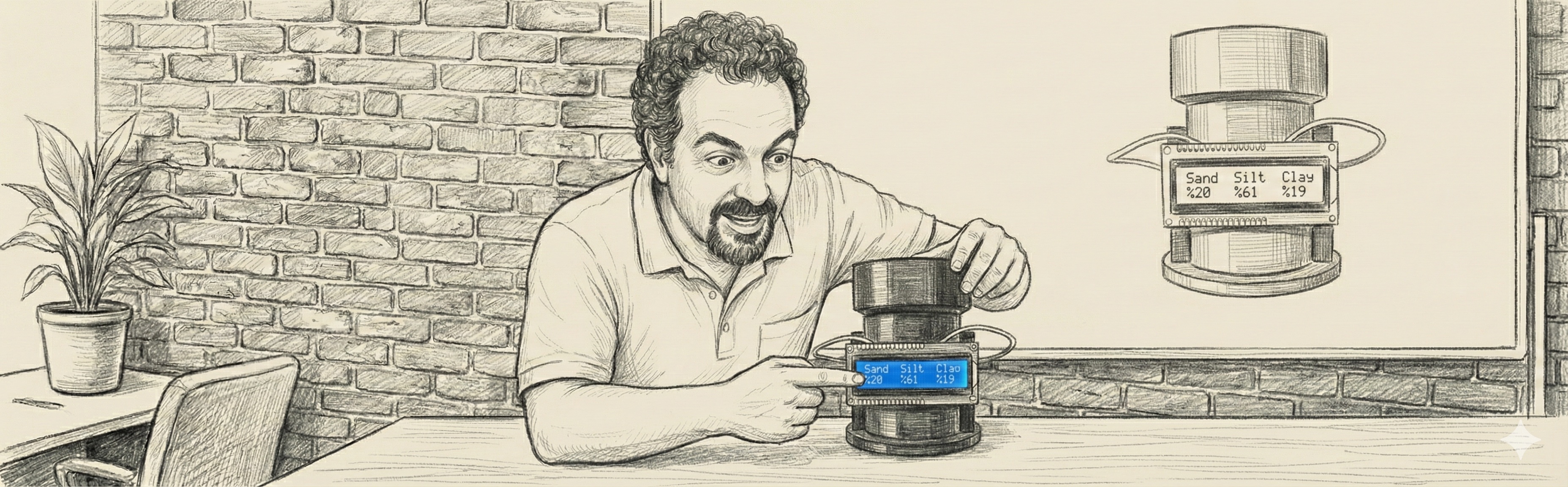
That was the moment the Digital Soil Texture Analyzer prototype was born — quietly, from a pulse of sound.
From there, it became a matter of refinement.
Combined with machine learning algorithms, our system could now estimate the proportions of sand, silt, and clay within soil samples — quickly, stably, and without any need for human expertise or additional equipment.
The elegant harmony between sensors, embedded systems, and predictive models transformed the soil from a mere laboratory sample into something that could be understood anywhere.
During the TÜBİTAK-funded project, three researchers grew with it — one PhD, two master’s students.
By the end, we had not only papers, presentations, and patents,
but a tangible reflection of scientific curiosity made mechanical.
Everything was beautiful — until the time came to turn it into a product.
That, as always, was another story.
📜 Publications
U. Orhan, E. Kilinc, F. Albayrak, A. Aydin, A. Torun. Ultrasound Penetration-Based Digital Soil Texture Analyzer, Arabian Journal for Science and Engineering, 47, 10751–10767, 2022. E Kilinc, U Orhan. Improving the accuracy of soil texture determination using pH and electro conductivity values with ultrasound penetration-based digital soil texture analyzer, PeerJ Computer Science, 11, e2663, 2025. —
🧾 Theses
- E. Kilinc (PhD, 2022) — Design of a soil texture analysis device based on ultrasound sensors and machine learning methods.
- F. Albayrak (MEng, 2021) — Shortening the test duration in LGB-based soil texture analysis.
🏅 Patents
- Ultrasound Penetration-Based Digital Soil Texture Analyzer, Turk-Patent, 2024.
- Soil Texture Analyzer, Turk-Patent, 2022.
🎥 Project Introduction Video
You can watch a short introduction of the project on YouTube:
▶️ Digital Soil Texture Analyzer — Overview Video