From time to time, I give motivational speeches to students and graduates about career paths and the changing landscape of technology. Below is the text of the most recent one, which I delivered at a Career Summit held within Çukurova Technopark.
Speech Transcript:
First of all, welcome everyone. There were some shifts in the schedule, and although I had planned accordingly, here we are.
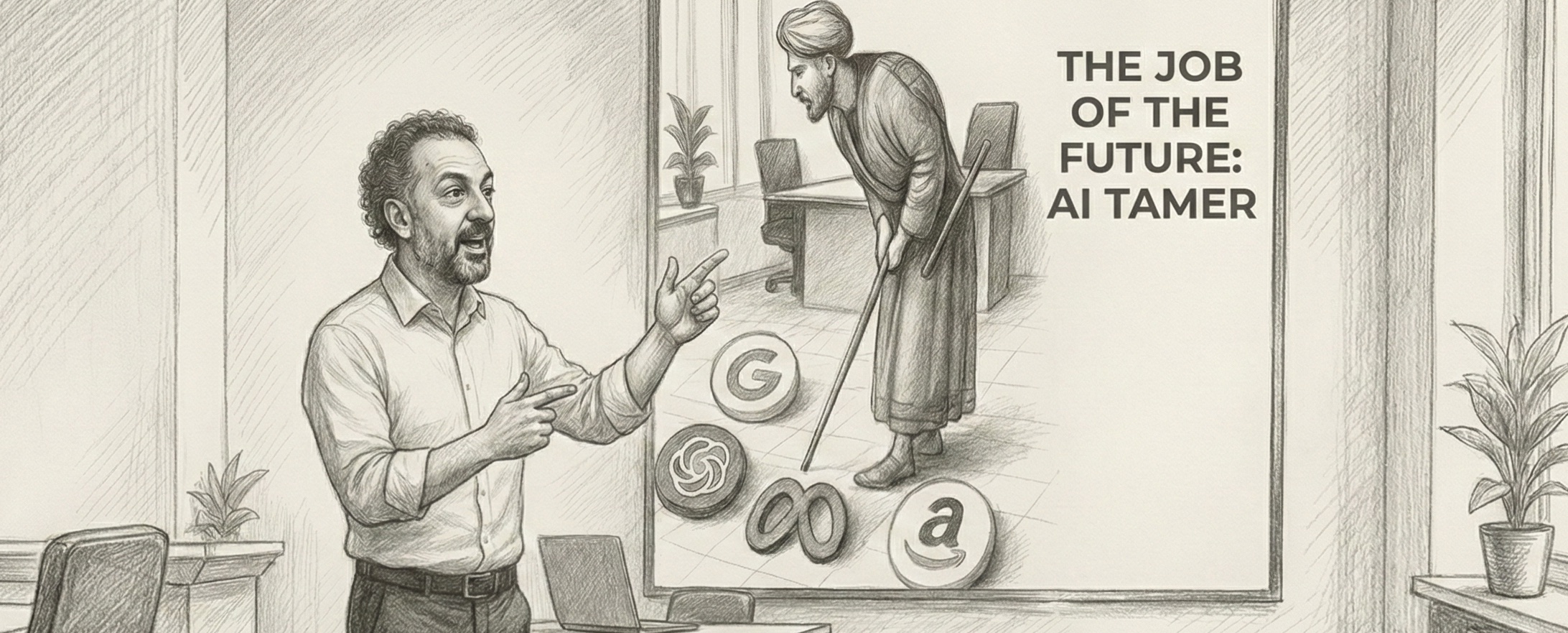
I want to start with the famous image I prepared as the cover, which many of you likely use or recognize. Does anyone recognize the figure in the painting?
A hybrid interpretation of Osman Hamdi Bey’s ‘The Tortoise Trainer’ adapted for the AI era.
Yes, it is Osman Hamdi Bey’s famous “The Tortoise Trainer.” However, as you know, new AI tools can reinterpret images in a “hybrid” way, merging them with other elements. I designed this cover specifically to illustrate this situation and prevent misunderstandings. I changed the tortoises at the bottom, replacing them with the logos of well-known AI giants. I also added an office environment to the background. You might notice that there seems to be a hidden stick in the trainer’s pocket; we can probably call that an AI error, or a “hallucination.”
Since we are at a career summit, it wouldn’t be wrong to start by asking, “What is the profession of the future?” When we think about it, it often feels like there is only one answer. Of course, there is no absolute answer. Some of you might say being a doctor, while others might point to the popular profession of our era: software engineering. Keep this question in mind; I will ask it again at the end.
Let me briefly talk about myself. Although I am introduced as the Head of the Computer Engineering Department, this is just the face of my love for computers. I fell in love with computers when I was just a sophomore in high school.
How did I realize this love? Thanks to a computer bought as a school gift and a magazine that came with it. Inside, there was a code written in “BASIC” language, and I had no idea what it did. Back then, a computer was just a box for playing games—and keep in mind, games weren’t at today’s level; even pressing keys was a game for us. When I typed those English words from the magazine into the computer, I saw the machine react. When I typed Print, it wrote something on the screen. I started testing if it would react to other English words in the dictionary. It didn’t react to most, of course, but it did to some, and this captivated me.
Until then, like most children raised in Turkey, I was conditioned to believe I would be a doctor. However, I changed my decision in the 10th grade and used all my university preferences for computer engineering. I call this my love, but actually, my love wasn’t the computer itself; it was the ability to make the computer do something and get an immediate response.
I realized this in my first year of university. It was when the internet was just becoming widespread. I remember upperclassmen asking, “Who is this rookie surfing the net every day?” In the second semester of freshman year, we started learning programming. I wrote codes to play games I knew, like Turkish checkers and Connect Four, against the computer. Of course, my programming knowledge was weak back then; I was writing rule-based things. I was telling the computer step-by-step what to do and how to do it. This is what we call “Expert Systems.”
Then, in 1996, when I was a sophomore in college, we heard that IBM’s Deep Blue had defeated chess champion Kasparov. More recently, in 2017, Google’s AlphaGo defeated the world Go champion. Google took IBM’s place, but the goal was always the same: to challenge human intelligence. I thought to myself: “AI is already a field I love, but if it has reached the point where it can beat the world’s best, where are we heading?” Still, I devoted more time to this field, not out of fear of unemployment, but purely out of curiosity.
Throughout my academic life, I took part in many projects involving AI. We developed an intelligent simulation for a game called Dice-Free Backgammon, designed assistant systems based on new algorithms to diagnose certain diseases from EEG and EKG signals, established an image processing system working in a chipboard factory, developed similar systems for a fruit juice factory, and proposed new regulations with algorithms detecting dictionary definition errors in Turkish.
When the pandemic hit and we were all locked in our homes, I baked bread and grew tomatoes like everyone else. But when I had too much free time, I started dreaming and writing a novel: Artificial World Colony (Yapay Dünya Kolonisi). This hobby work has now turned into a series sold on Amazon. I am about to finish the third one.
When writing science fiction, your dreams are big; you wonder, “Could this turn into a Hollywood movie?” However, I realized something: New-generation AI companies are just as much dreamers as I am. They have practically established a second Hollywood; they are producing incredible scenarios in Silicon Valley.
For example, in 2017, Facebook (now Meta) spread a story like, “Two chatbots developed a secret language between themselves, luckily an engineer pulled the plug and saved humanity.” The technology of that time was not capable of this. The article titled “I do not plan to destroy humanity,” which OpenAI had GPT-3 write for The Guardian in 2020, was also an incredible PR stunt. Today, we know GPT’s capabilities; it does excellent work, but it doesn’t even come close to human intelligence, imagination, or interpretation skills. Since we work algorithmically, we know the background. I used to think Google wouldn’t get caught up in this “childish” excitement, but in 2022, a Google engineer claimed, “This AI has come to life, it has consciousness.” I realized that Google had also joined this “Hollywood” scene.
Look, there is no need to exaggerate. If there really were a human-like intelligence, it would develop through interpretation skills, not just by loading information. Today, when I ask GPT-5 to “Make a joke,” it can make a context-appropriate joke based on the Tortoise Trainer image I showed at the beginning, saying, “The Trainer has tamed Google and the other logos.” But this doesn’t mean it is intelligent. In the background, an advanced “expert system” is working, analyzing the commands (prompts) I give and adapting them to existing templates.
Let’s return to our topic: unemployment. Every new invention changes some values of the previous era and leaves some people unemployed. When the printing press arrived, the work of scribes writing manuscripts decreased, but it didn’t end in a day. Although demand decreased, since the population increased, they continued for a while longer. However, because the new generation didn’t learn that old job, a natural transition occurred.
When machines arrived, production increased, and job descriptions changed. The situation is similar with AI. Every invention creates a solution and at least one problem. The automobile solved transportation but brought the fossil fuel problem. Electric vehicles came; they brought battery and software problems. Every problem means a new field of work.
What scares us about AI is the speed. For example, let’s talk about our local language model heard recently, “Kumru.” There is a situation in the market: Companies take Meta’s open-source LLaMA model, train it on Turkish data, and say, “We trained it entirely in Turkish.” Training a model from scratch (pre-training) is very costly and difficult; what is usually done is fine-tuning. Although Kumru’s claim is big, it is actually a LLaMA-based system. When you look at the answers it gives to questions, you see that it doesn’t create a sensational difference. But we must continue on this path. The first GPT models weren’t perfect either. As they are used, and as new data is produced from incorrect answers, the system improves. You are updating the data, not the intelligence.
This is where the opportunity of the future lies: Data.
Think about the difficulties we face in searches within our health system’s “What do I have?” application or legal precedents. National systems can be established that give correct answers to citizens asking, “I have this ailment, which doctor should I go to?” or “I have this legal issue, what should I do?” The only obstacle to this is that data has not been collected in a way suitable for these systems.
In the future, there will be a need not just for computer engineers, but for domain experts who can make the data of their own field suitable for AI. If you are a lawyer, you must be a lawyer who knows how to process legal data.
Young people are already catching this change. Even Sumerian tablets have inscriptions saying, “Where is this youth going?” The new generation is always different from the old. The ones in real danger are the young people influenced by the ‘narrow-minded’ old guard who say, ‘I’m already doing my job, I don’t need AI.
Remember! If you want to pass the leader, you must first be a close second who follows them closely. You can only seize the opportunity to get ahead when the leader stumbles.
So, which professions are at risk?
I still don’t have clear answers to some questions. Will AI make us lazy? Yes, you may not need to keep information you don’t use frequently in your memory. But you must cache critical information related to your job in your brain so you can produce quick solutions. Should we stop giving homework to students? We will give it, but we will change the format of the homework. Is it possible to educate a human like a robot? No, emotion and motivation will always be necessary.
I want to end the speech with the question I asked at the beginning: What is the most popular profession for tomorrow’s world?
I don’t have a single answer to this. Do not let circumstances force you to give up on the love of your life (for me, it was computers) or your dreams (for me, it was writing novels).
However, “fine-tuning” is always good. Just as we optimize AI models with fine-tuning for a specific task, be flexible as you move toward your goals. The road may not go straight; there may be curves. Be prepared for those curves.
Thank you for listening.