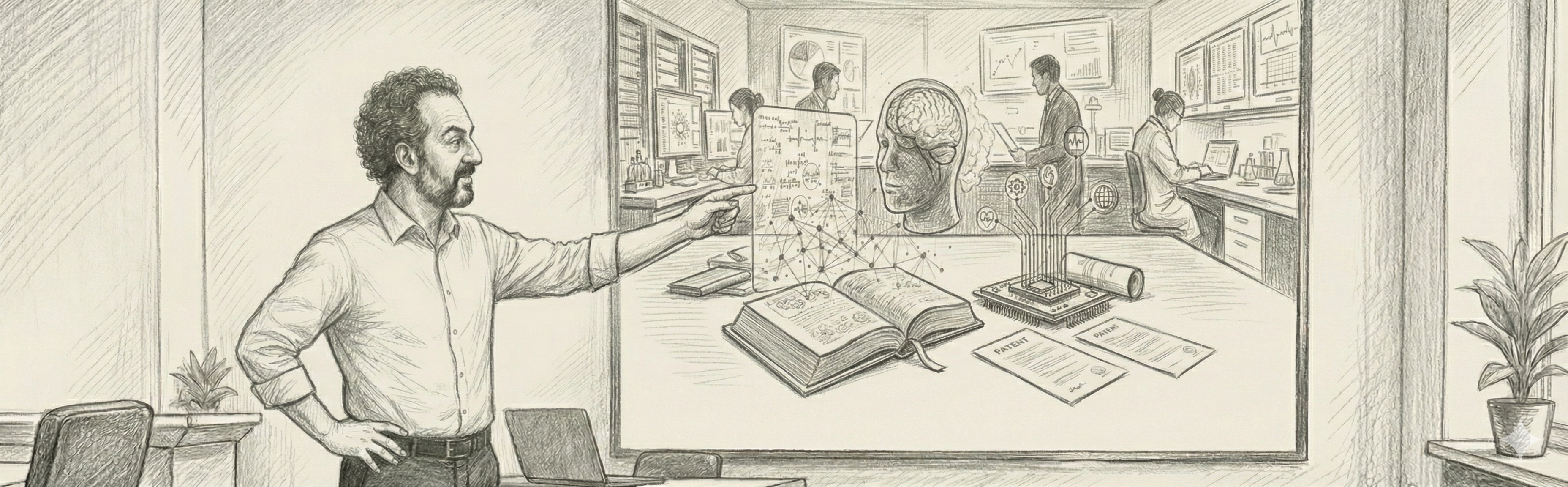
In this post, I will share the story of a method—based on discretization-based probabilities for time series classification—that became the starting point of my academic career and professional passion. What began as a doctoral thesis project has evolved into a globally recognized path, inspiring diverse applications across the international academic community.
During my doctoral work, I was searching for a more effective way to make sense of complex and irregular time series (such as biological signals or vibration data). Traditional methods struggled to capture the deep underlying patterns within this data.
This led me to develop a novel method that utilizes the concept of discretization to convert time series into simpler, finite states. The probability distributions derived from these states are then used as a unique “fingerprint” for classification.
The first application of this method was directly related to my thesis topic: epilepsy detection. My new approach could successfully distinguish the subtle changes in EEG (electroencephalogram) signals. Crucially, in addition to existing methods that detect obvious changes during and before a seizure, my method could also distinguish subtle changes in patients who were not experiencing a seizure.
This research journey resulted in 3 prestigious international journal articles and 3 conference proceedings. Among these publications, one journal article, in particular, attracted interest far beyond my expectations and remains a highly cited reference to this day. **
When I began reviewing the citations and the journals where the articles were published, the mixture of surprise and pride I felt was immense. I saw that my simple yet powerful method, which started with a medical purpose, was being used in completely different sectors and scientific fields that I hadn’t initially imagined.
The fact that a method born out of a theoretical study didn’t remain solely theoretical but instead brought solutions to practical problems, serving as a source of inspiration for so many different applications, was one of the greatest satisfactions of my academic work.
Following this global recognition, I decided to apply the method to new challenges in my own field:
These new applications further demonstrated the robustness and generality of the method.
The story didn’t end there. The fundamental idea behind this discretization-based probability method continued to evolve, eventually forming the basis of an entirely new research direction.
The work stemming from this core idea indirectly led to:
It was hard to imagine that a humble idea beginning as a PhD thesis would create such a significant and widespread impact over the years. This journey is living proof that even a small spark of academic research can ignite a fire that illuminates the entire world.
As I continue my academic journey, I realize anew how valuable it is to pursue such innovative ideas. You can find my publications related to the method on the “Publications” section of my website.